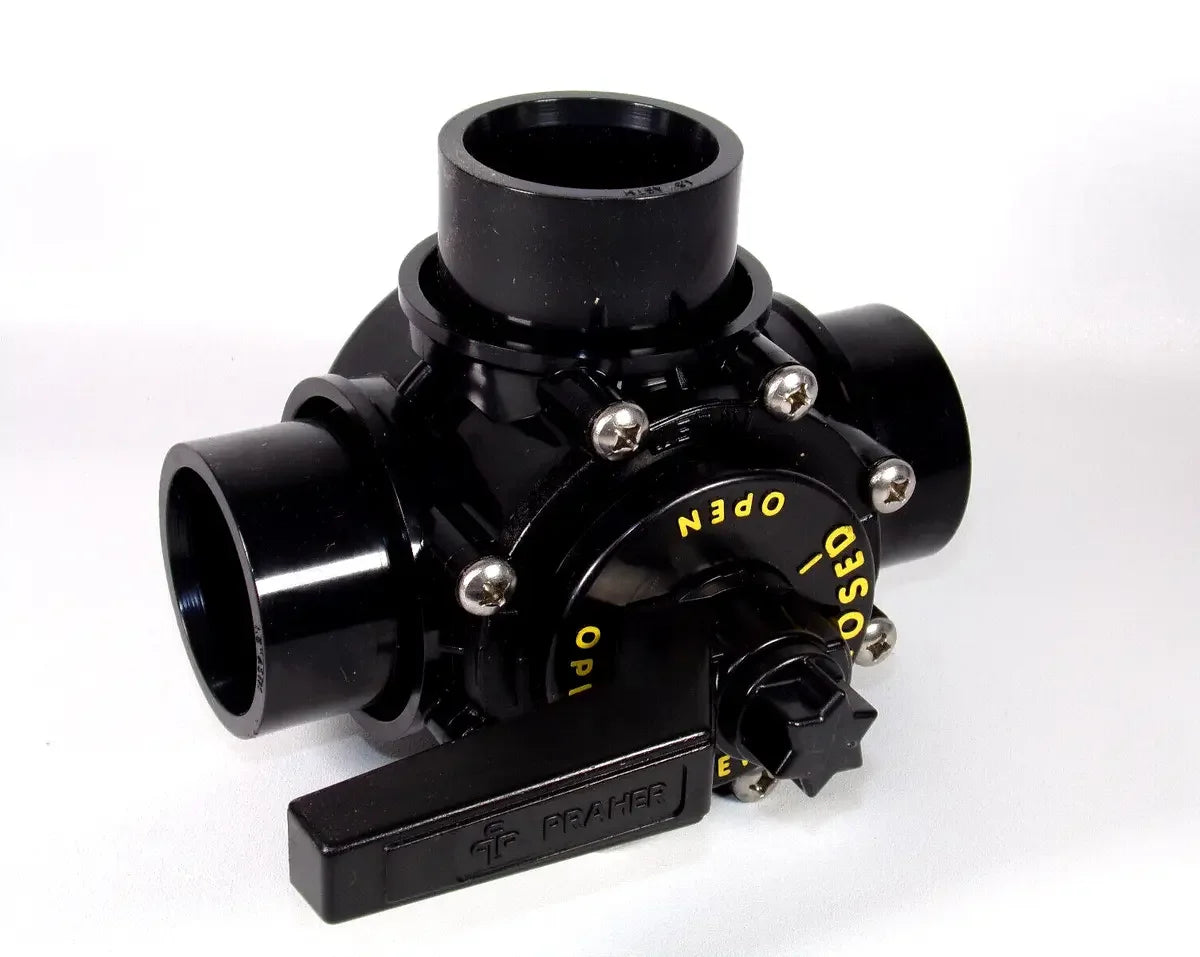
In brief: Praher OV3-1500 3-way diverter valve, CPVC body, 1½ in. inside or 2 in. outside connections, double O-ring shaft seal and permanently lubricated rotor seal. Designed to remain easy to operate season after season, even when exposed to the sun.
A valve that sticks or warps is almost always a material issue
An ordinary PVC diverter valve installed in direct sunlight, or just downstream of a heater, softens with the heat. The cover warps slightly, the rotor binds, and you find yourself slapping the handle with your palm to make it turn. Over time, the seal dries out and the valve leaks around the shaft.
CPVC tolerates considerably higher temperatures than standard PVC. That’s the reason this valve exists: it’s made for places where an ordinary valve doesn’t hold up well.
What the OV3-1500 does
- High-temperature cover that won’t warp in the sun
-
Double O-ring shaft seal
-
Permanently lubricated, highly wear-resistant rotor seal that exceeds the 3,000 dry-cycle requirement
- Construction resistant to chlorine, acid and ozone
- Proportional mixing: the handle can be left in an intermediate position to distribute flow between the two outlets
- 18-8 stainless steel “Plast-Tite” screws
Specifications
| Part number |
OV3-1500 |
| Manufacturer |
Praher |
| Type |
3-way diverter valve |
| Material |
CPVC |
| Connections |
1½ in. inside diameter, 2 in. outside diameter |
| Working pressure |
50 psi |
| Approval |
Materials in contact with water, NSF-50 or NSF-61 designation |
| Sealing |
Double O-ring on shaft, lifetime-lubricated rotor seal |
How it connects
The body accepts a 1½ in. pipe glued inside the outlet, or fits over the outside of a 2 in. fitting. One valve therefore accommodates the two most common sizes in residential pool plumbing, with no adapter.
Install unions on both sides if you want to be able to remove the valve later without cutting the plumbing.
Frequently asked questions
How is it different from an ordinary 3-way valve?
The material. This one is made of CPVC rather than standard PVC, so it can tolerate higher temperatures without warping. It’s the right choice downstream of a heater or heat pump, and for plumbing exposed to direct sunlight.
Can I use it to mix flow between two outlets?
Yes. The handle can be left in an intermediate position, distributing flow between the two outlets rather than diverting it entirely to one side.
Is it suitable for a salt system?
Yes. The construction resists chlorine, acid and ozone.
Does the seal need to be lubricated after installation?
No. The rotor seal is permanently lubricated during manufacturing.
What pressure can it handle?
50 psi working pressure, which is more than enough for residential pool plumbing.
Other plumbing parts